
Project L: Riot's Free-to-Play Fighting Game Vision and the Arrival of Illaoi
Project L, Riot Games' highly anticipated assist-based fighting game, promises a meticulously crafted free-to-play experience with a deep, strategic roster. The exciting introduction of Illaoi expands the diverse champion lineup, ensuring captivating competitive and social gameplay for all fans.
As a player who's been following Riot Games' projects for years, I was thrilled to finally get a substantial update on Project L. It's been a long wait since the initial 2019 announcement alongside Legends of Runeterra and Valorant. The fact that it's still called a "project" might hint at a meticulous, slower development pace, but honestly, I'd rather have a polished game than a rushed one. The recent dev diary brought some fantastic news: Project L will be free-to-play. This doesn't surprise me one bit, given Riot's successful track record with League of Legends and Valorant. Their executive producer, Tom Cannon, emphasized their goal is to remove as many barriers as possible for players to jump in and enjoy the game. He also promised monetization that respects our time and wallets, which is a relief to hear in today's gaming landscape. The core philosophy seems intact—a game that's easy to learn but hard to master, just like League. Now, that's a promise I can get behind.
🔥 The Core Gameplay & Development Progress
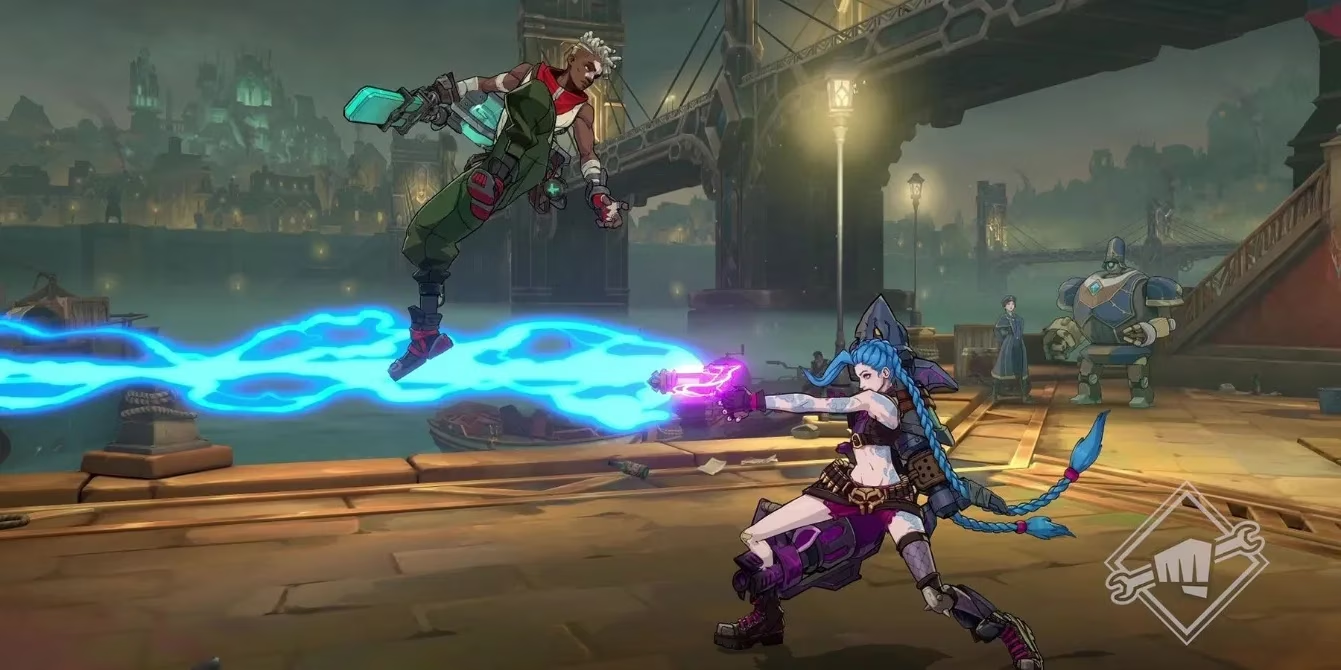
Let's talk about what makes Project L tick. Back in the 2021 trailer, Riot revealed it would be an assist-based fighting game with two fighters per team. This immediately piqued my interest because it suggests a deep layer of strategy and teamwork, blending traditional fighting game mechanics with cooperative play. According to the latest update, the team is finishing up work on the core mechanics. Most developers have now moved on to building out broader game features. This is exciting progress! They're focusing on:
-
Competitive play systems – ensuring ranked modes and balance are top-notch from the start.
-
Social systems – because what's a Riot game without a strong community backbone?
-
Expanding the character roster – and this is where things get really juicy.
The commitment to a diverse and inclusive roster is a huge plus. Fighting games live and die by their character selection, and Riot's vast League of Legends universe gives them an incredible pool of champions to draw from.
⚔️ The Growing Champion Roster: Welcome, Illaoi!
The biggest reveal from the dev diary was the introduction of Illaoi, the Kraken Priestess, as the next champion joining the fray. She's a fantastic choice—a powerful, zone-controlling fighter whose tentacle-summoning gameplay from League could translate into something truly unique and visually spectacular in a 2D plane. She will join the five previously confirmed champions, making the current known roster:
| Champion | Role in League (Likely Archetype in Project L) |
|---|---|
| Ahri | Mage/Assassin (Mobile, combo-heavy) |
| Darius | Juggernaut (Powerful, close-range grappler) |
| Ekko | Assassin (Time-manipulation, reset potential) |
| Jinx | Marksman (Long-range, chaotic zoning) |
| Katarina | Assassin (High-mobility, reset-focused) |
| Illaoi | Juggernaut (Area control, tentacle summons) |
Tom Cannon mentioned the team wants each champion to "deliver more than what players expect." This tells me they're not just doing simple port-overs. They're reimagining these iconic characters for a fighting game context, which could mean new moves, mechanics, and playstyles that honor their original lore while offering fresh depth. I can't wait to see how Illaoi's spiritual themes and heavy-hitting style are adapted.
💰 The Free-to-Play Model & What It Means for Us
Riot's confirmation of a free-to-play model is a game-changer for the fighting game genre. Here’s why I think it’s a brilliant move:
-
Low Barrier to Entry: Anyone can download and try it. No upfront cost means my entire friend group can jump in without hesitation.
-
Sustainable Ecosystem: Based on Riot's history, we can expect monetization through:
-
Cosmetic skins (imagine the possibilities for these fighters!)
-
Possibly champion unlocks (hopefully earnable through play)
-
Battle passes or other progression systems
-
Long-Term Support: A successful live-service model means continuous updates, new champions, balance patches, and events, keeping the game alive for years.
Cannon’s promise of a respectful model is crucial. I don't want a grind-fest or pay-to-win mechanics. If it's anything like Valorant or League, where you can earn most content through play and only pay for cosmetics, I'll be a happy camper.
⏳ The Release Timeline & Final Thoughts
Now, for the million-dollar question: when is it coming? Unfortunately, Riot still doesn't have a firm release window. Cannon promised one more update later this year (2026), and I'm sincerely hoping it includes at least a target year or a beta announcement. The development seems to be in a healthy state—core mechanics are wrapping up, and feature development is underway. A 2027 release or a late-2026 beta doesn't seem out of the question.
To summarize why I'm so excited:
-
✅ Free-to-play model removes entry barriers.
-
✅ Assist-based 2v2 gameplay offers a fresh take on the genre.
-
✅ Riot's design philosophy of "easy to learn, hard to master."
-
✅ A growing, diverse roster starting with iconic champions like Illaoi.
-
✅ Monetization focused on player respect.
Project L is shaping up to be more than just another fighting game. It feels like Riot's attempt to merge the best parts of the fighting game genre with their proven live-service expertise, all set in the rich world of Runeterra. The wait is tough, but these updates assure me they are building something special. I'll be keeping my eyes peeled for that next update later this year. Until then, I'll be theorizing about which champion joins the roster next—maybe a tricky support like Thresh or a durable tank like Braum? The possibilities are endless.